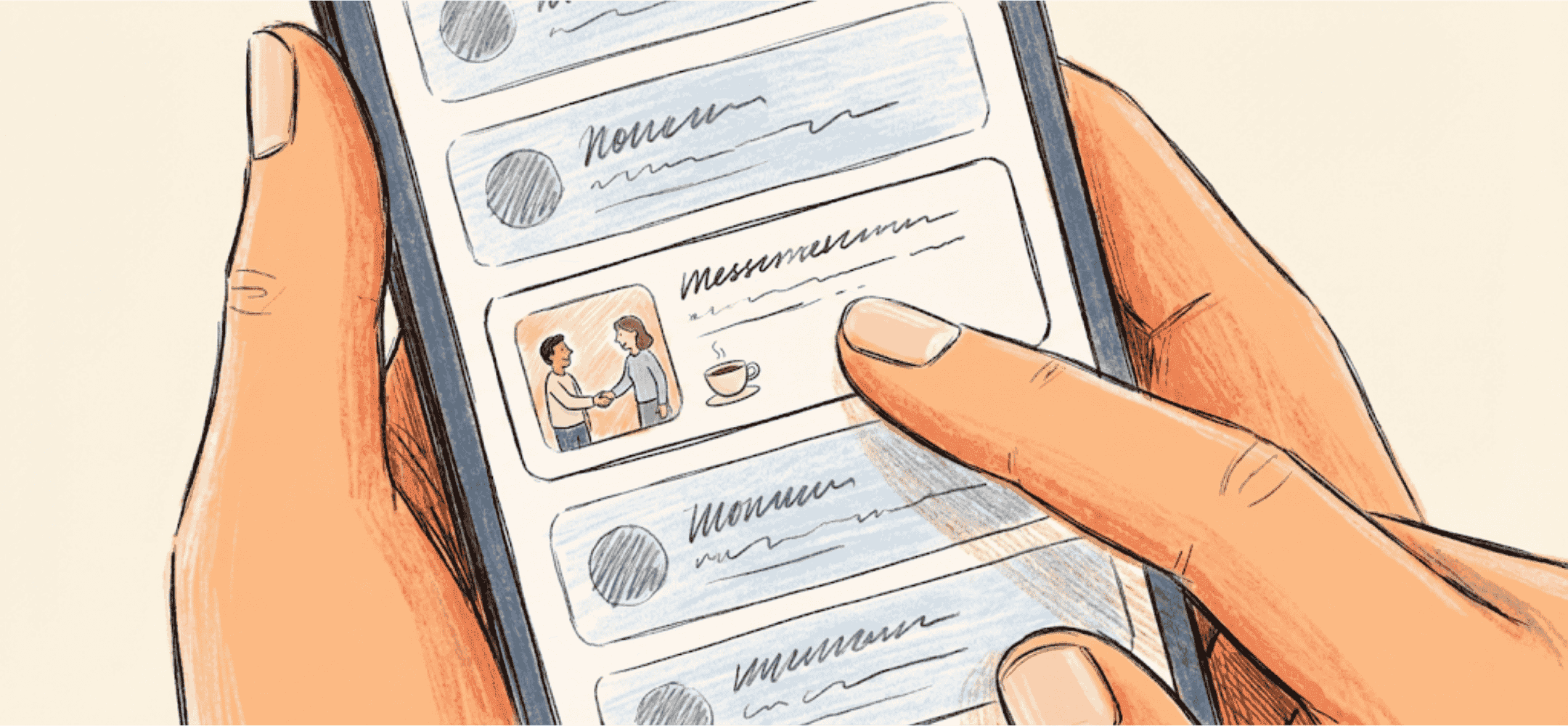
LinkedIn Recruiter Message Examples: 8 That Get Replies
Looking for LinkedIn recruiter message examples? Get 8 ready-to-use messages for different situations, plus tips on InMail, follow-ups and personalisation.

Successful LinkedIn outreach comes down to personalisation, relevance and a concise structure of 80 to 150 words with a low-key closing line.
A good LinkedIn message example for recruiters is short, personal, and directly relevant. You show why you're reaching out to this specific person, mention something concrete, and close with a small question. That makes the message feel targeted rather than generic, which lifts your reply rate. In this article you'll find ready-to-use examples for different situations, plus a short explanation of why each one works.
- Short, personal messages get replies more often than long ones.
- A strong hook decides whether someone keeps reading.
- Adapt every recruiter message example to the audience and the context.
- A small, clear question leads to more answers.
When a LinkedIn message example for recruiters works (and when it doesn't)
A LinkedIn message example only works when it genuinely fits the person and the moment. Candidates judge relevance in seconds, so a generic message rarely lands. You see this most often with standard outreach that has no clear reason behind it.
Context matters a great deal when you approach a candidate on LinkedIn. A developer cares about the tech stack and freedom in technical decisions. A nurse looks more at the team and the rota, while a finance professional wants clarity on stability and impact. If the content doesn't match that, the recipient loses interest fast.
The type of message matters too. A connection request example from a recruiter should stay short and low-pressure by default. A LinkedIn message from a recruiter sent after acceptance can carry more context. An InMail example for recruiters needs a touch more clarity, simply because you're reaching out without an existing connection.
How to build a strong LinkedIn message example to send as a recruiter
An effective message tends to follow a fixed structure. This helps you write clear, relevant messages quickly, even when you're working from a recruiter outreach template.
- Trigger: why are you sending this message right now?
- Why this person: what stood out to you on their profile?
- Relevance: why might this be interesting to them?
- Small CTA: a clear, simple next step.
Keep your message between roughly 80 and 150 words. Our own experience and general recruitment statistics both show that shorter messages get read far more often. Candidates skim the text and decide within seconds whether to reply.
8 situations with a working LinkedIn message example for recruiters
Reaching out to a senior developer
Context: substance, autonomy and the tech stack matter enormously in a LinkedIn message to a senior developer.
Hi Mark, I noticed you work a lot with Node and AWS in a high-traffic environment. Your recent migration project in particular caught my eye. I'm currently talking to a scale-up that's rebuilding its platform from the ground up, with plenty of room for your own technical decisions. That's exactly why I thought of you. Would you be open to a quick 15-minute chat to see if this could be interesting?
Why this works: you open with substance and show you've actually studied their profile. The closing question is specific and easy to say yes to.
Reaching out to a nurse
Context: the team, the rota and workload matter a great deal in a recruiter message to a nurse.
Hi Anne, I saw you've been working in cardiology for a number of years now. That's brilliant work, but it also comes with real responsibility. I'm currently supporting a hospital where rotas are genuinely built in consultation and fixed teams come first. Given your background, I immediately thought of your experience. Would you be open to hearing, with no obligation, how they've set that up?
Why this works: you link the candidate's current situation to a concrete, positive difference in the new workplace.
Reaching out to a finance professional
Context: stability and influence are what count in a message from a finance recruiter.
Hi David, your solid controlling experience in a manufacturing environment really stood out to me. I'm currently working on a role where you'd be actively involved in investment decisions and report directly to the board. It's also a stable, growing organisation. Could I give you a quick call soon to see if this fits where you want to go next?
Why this works: you name the role's impact directly while also offering a sense of security.
Reaching out to a graduate
Context: good guidance and development opportunities are what matters most in a recruiter message to a graduate.
Hi Lisa, congratulations again on finishing your Business degree! I saw on your profile that you completed a successful placement in supply chain. I'm currently talking to an organisation offering a challenging graduate programme with hands-on mentoring. I'd love to hear what you're actually looking for at this stage of your career. Would it be alright if I gave you a quick call about it soon?
Why this works: you keep the approach personal and low-pressure by closing with an open, easy question.
Reaching out to a passive candidate with long tenure
Context: acknowledge, respectfully, that this person is probably not actively job-hunting right now.
Hi Tom, I noticed you've been with the same organisation for six years now. That says a lot about how committed you are. I've no idea whether you're open to anything new at all, but I came across a role that fits your extensive process optimisation experience remarkably well. Mind if I send you a short message on why I thought of you specifically?
Why this works: the approach is refreshingly honest and human, and it shows real respect for loyalty.
Following up after no response
Context: keep it short and always add something new in a recruiter's follow-up message.
Hi Mark, just a quick addition to my earlier message. I've since had more detail on the technical roadmap. Internally, the focus there is very much on scalability and giving people real input. Let me know if it's worth discussing this together soon?
Why this works: you deliver new, relevant information without repeating yourself.
A networking message with no specific vacancy
Context: building a long-term relationship without offering a role straight away works well through a networking message with no vacancy attached.
Hi Sara, I've been following your updates on data analytics for a while now. It's fascinating to see how you're applying AI within marketing in practice. Since I speak with a lot of professionals in this field, I like to swap notes and ideas. Would you be open to a quick call sometime soon, purely to connect, no vacancy in mind?
Why this works: there's no pressure on the conversation at all, and it's an easy first step to take.
Re-engaging after earlier contact
Context: build smoothly on a previous conversation with a candidate re-engagement example.
Hi Kevin, we spoke last year about that specific back-end role. At the time, you said it wasn't quite the right moment to move. Since then, that same team has gained a lot more room for architecture work and independent technical decisions. That's why you came to mind again. Could I give you a quick update soon on exactly what's changed?
Why this works: you reference the past while making it crystal clear what's genuinely different now.
Want to see for yourself what better messages can do at team level? Take a look at our Vibe Group case study, where both the reply rate and the quality of conversations improved visibly.
Write a personal message right here
Enter a name or LinkedIn URL and get a personalised message within 30 seconds. No account needed.
Common mistakes in a LinkedIn message example sent by a recruiter
A common pitfall is sending messages that are far too long. Candidates simply aren't waiting for lengthy, wordy introductions. They want to understand straight away why you're contacting them specifically. That's exactly why a short, crystal-clear opening tends to work best.
Overly generic messages with no concrete observation also backfire. A good LinkedIn message example for recruiters should always include at least one genuinely personal detail. Without it, the message instantly reads as an impersonal bulk send, which drops your reply rate sharply.
Another classic mistake is leaving out a clear question. Without an obvious call to action, the reader has no idea what the next step should be. Keep your closing question small, specific, and easy to answer.
Improving a LinkedIn message example for recruiters with personalisation
Thoroughly personalising every message takes time, especially when you're reaching out to dozens of candidates a day. That's why many recruiters fall back on a fixed recruiter outreach template. While that saves real time, it can also quietly lead to predictable, dull messages over time.
The sweet spot is a tight structure combined with enough variation. You keep the fixed framework, but carefully tailor the specific content per person. Smart tools can make a real difference here. With our module for writing personal InMails, you use real profile information as input and then simply adjust everything yourself. That way, every LinkedIn message from a recruiter still feels genuine and personal.
Especially for high-volume teams, as we regularly see at recruitment agencies, this approach delivers consistent quality without outgoing messages turning generic and flat.
Handy checklist for every LinkedIn message example sent by a recruiter
- Is it immediately clear why you're reaching out to this specific person?
- Does the message content match their work experience and context well?
- Do you name a concrete, accurate observation from their profile?
- Do you close with a small, clear question?
- Is the message reasonably short and easy for the reader to scan?
- Does the tone of voice genuinely fit this specific audience?
Want to put these practical tips into action straight away? Head to try it yourself and test your own improved messages in your daily workflow today.
Frequently asked questions
Want to put these practical tips into action straight away? Head to try it yourself and test your own improved messages in your daily workflow today.
Short and to the point works best by far. Aim for a clear, compact text of roughly 80 to 150 words, so the recipient immediately understands why you're getting in touch.
You send an InMail to someone you don't yet have a connection with. That naturally calls for a touch more context and professional clarity. A regular message usually follows after a connection request is accepted, so it can often afford to be a little more informal from the start.
By using a solid, fixed base structure, you only need to rewrite a sentence or two per message based on someone's specific work experience. That relatively small effort quickly makes a world of difference to the candidate.
Usually it simply comes down to a lack of relevance, messages that are too long and hard to follow, or no clear question at all. A few targeted, small tweaks to your opening and your call to action often deliver noticeably better results straight away.
Write a personal message right here
Enter a name or LinkedIn URL and get a personalised message within 30 seconds. No account needed.
Want to boost your LinkedIn outreach response?
Elvatix optimises your recruitment workflow with smart message templates and personalisation tools tailored to the needs of different audiences.