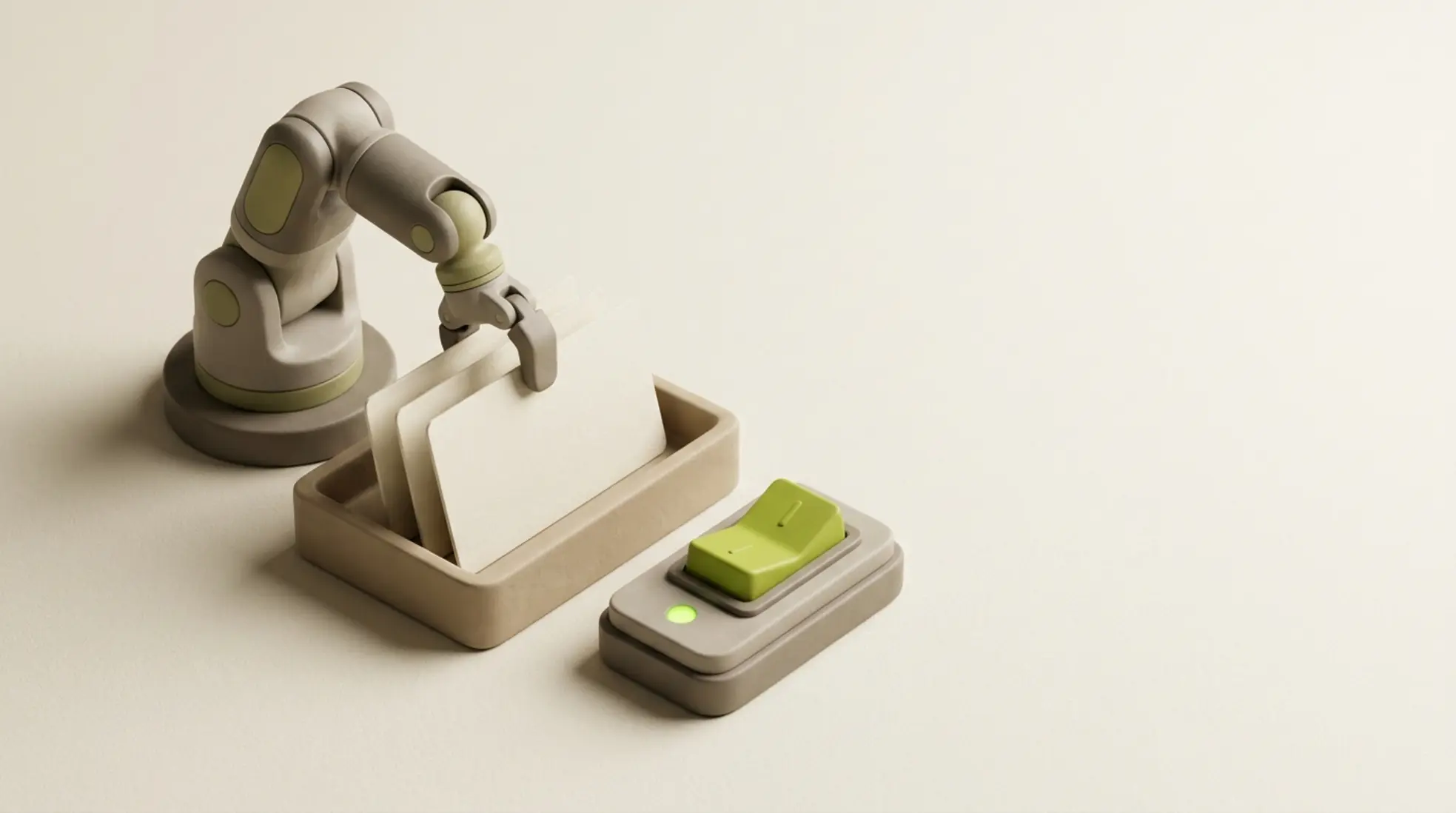
AI in the candidate experience: the role of the bot and the human in recruitment
AI in the candidate experience: what can a bot handle, and where do you still need human control? Learn the tasks, risks, rules and the right KPIs.

Optimise the candidate experience by using AI's speed for procedural tasks, while the recruiter stays responsible for empathy and decision-making. Transparency about bot use is essential here to maintain candidate trust.
AI in the candidate experience works well when you combine speed with clear rules and human oversight. A bot can accelerate plenty of tasks, but it shouldn't make decisions that directly affect candidates. That's why you set clear boundaries: what exactly do you automate, and when does a recruiter take over? In this article, you'll learn how to set that up in practice.
- Fast responses reduce the chance that candidates drop out early.
- Clarity about who or what the candidate is speaking to prevents distrust.
- A human remains essential for judgement calls, uncertainty and highly sensitive situations.
- Analysing the data shows you exactly where AI genuinely adds value.
What does AI in the candidate experience mean in recruitment practice?
AI for the candidate experience means using artificial intelligence to make the application experience faster and clearer. Think of an application chatbot that answers questions, sends automatic acknowledgements, and provides AI-driven follow-up through handy reminders. This AI-supported candidate journey starts right at first contact and runs seamlessly through to onboarding.
At its core, it's actually quite simple: candidates want speed, clarity and the option to speak to a human. AI for candidate communication helps you deliver that consistently. The recruiter remains ultimately responsible for the content and the judgement calls. That distinction always needs to stay clearly visible to the candidate.
Why AI in the candidate experience brings speed, but also risk
Because AI responds instantly, even well outside office hours, response times drop sharply and more candidates complete their application. Automated follow-up also significantly cuts the number of no-shows. This makes hiring processes more predictable and far more scalable.
A problem arises, though, when it isn't immediately clear that an applicant is talking to a recruitment bot. That creates confusion and can damage early trust. Transparency about the use of bots is therefore absolutely essential. Simply explain that it's a digital assistant, and tell candidates how they can easily reach a real recruiter. That puts the candidate at ease and prevents unnecessary frustration.
Which tasks a bot can handle well in the AI candidate experience
A bot works brilliantly for tasks with clear rules that need little interpretation. These are practical applications that deliver tangible value in most recruitment teams straight away.
- Acknowledgement: candidates know immediately that their application has been received and what the concrete next step is.
- Frequently asked questions: an application chatbot answers practical questions about location, working hours and required documents in an instant.
- Collecting basic information: details such as availability or right to work are remarkably easy to structure this way.
- Scheduling and follow-up: by automating reminders and follow-up, you keep the process highly consistent and easy to track.
- Status updates: short messages with no substantive judgement attached keep candidates closely engaged throughout the process.
In all of these situations, the technology only supports the process; the actual decision always stays in the recruiter's hands.
Tip: Elvatix gets more out of every InMail credit. Higher response rates, lower cost per contact.
See how →Which tasks you shouldn't fully automate when using AI for the candidate experience
Some critical moments simply need more context and nuance. At those points, human judgement is genuinely indispensable. That's why you set clear boundaries here.
- Rejections with an explanation: this calls for extremely careful communication and enough room for any follow-up questions.
- Salary conversations: good negotiation depends heavily on the candidate's personal situation and expectations.
- Sensitive topics: empathy and the right timing play a decisive role in these situations.
- Assessing soft skills: traits such as collaboration genuinely require human interpretation and life experience.
- Exceptions: standard logic simply isn't reliable enough in strongly deviating or unusual cases.
This is where the concept of recruitment with a human in the loop comes in. It explicitly means a human recruiter can step in, adjust course and ultimately decide at any point.
When to always involve a human in AI-driven candidate experience
There are fixed moments in the journey where you hand the interaction over to a recruiter seamlessly. This naturally happens when a candidate explicitly asks for it, or when the AI is unsure of the right answer. Complaints or signs of frustration are also strong signals to step in. Finally, sensitive or complex topics always call for genuine human attention.
This matters enormously for larger teams especially, which is strongly the case for corporate recruiters. Your employer brand is closely tied to how you communicate. That's why the route to human contact needs to be instantly findable and very low-threshold.
How AI in the candidate experience fits with regulation and transparency
Given data protection law (UK GDPR), you're required to explain clearly what you do with the personal data you collect and exactly why you do it. The candidate needs to explicitly know that artificial intelligence is involved; that's the non-negotiable baseline requirement. On top of that, transparency obligations under emerging AI regulation, such as the EU AI Act, mean you should make it clear in advance exactly where AI plays a role in your process.
Fully automated decisions with a significant impact on a candidate are only permitted in very limited circumstances. There must always be an easy option for human review of that automated decision. Explain this directly and unambiguously in all your outward communication. Genuine transparency removes distrust and prevents complicated discussions further down the line.
How to keep the AI candidate experience human through language and tone of voice
Many AI-generated messages can feel a bit distant, mainly because they're too generic in nature. This is often caused by relying on rigid standard templates. So choose simple, natural and very direct language instead. Tell the candidate plainly what you're doing, and explain clearly why.
Practical examples help make this concrete straight away. Think of lines such as: "I'd be happy to help you schedule a first conversation," or: "This message was sent automatically, but of course you can also speak to a recruiter." Sometimes it also helps to emphasise: "This isn't a final decision yet." This open approach makes the AI candidate experience immediately clear, pleasant and honest.
How to measure and improve AI applications within the candidate experience effectively
Only by measuring data do you discover whether the use of technology genuinely works. Set up an A/B test with two groups, for example: one process with AI and one without. Just make sure there are enough candidates in the test group for the results to be statistically reliable.
Important KPIs to keep a close eye on are average response time, completion rate and recruitment NPS. Also look closely at complaints received, escalations to staff, and exact drop-off moments. All of this data shows, unforgivingly, where friction arises in the process. Based on these insights, you can then optimise the AI-supported candidate journey in a highly targeted way.
Do's and don'ts by stage of the candidate journey
Apply
- AI may: send confirmations, answer practical questions and request required documents.
- AI may not: automatically reject candidates without any form of human oversight.
- Human needed: when genuine doubt arises or the input is very unclear.
Screen
- AI may: check fully objective criteria and schedule interviews independently.
- AI may not: assess a candidate's soft skills on its own.
- Human needed: to carefully interpret prior work experience and stated motivation.
Interview
- AI may: send automatic reminders and structure the interview thoroughly.
- AI may not: make decisive, substantive decisions about the outcome.
- Human needed: for the final assessment and giving feedback.
Offer
- AI may: prepare formal documents such as the employment contract at speed.
- AI may not: take over the actual, sensitive negotiations on terms of employment.
- Human needed: for fine-tuning, mutual understanding and any verbal explanation of the offer.
Onboarding
- AI may: efficiently share handy, purely practical company information with the new employee.
- AI may not: try to resolve a candidate's personal doubts or individual concerns.
- Human needed: for highly specific or personal questions about the future role and the atmosphere within the team.
The practical next step: keep maximum control over your workflow
AI technology really comes into its own once it handles the groundwork smartly, after which the recruiter makes the final call. This delivers the speed you want, with zero loss of control. Read the page on how it works to see exactly how this modern collaboration is set up in practice.
Want to see the exact impact with your own eyes? Then take a look straight away at the inspiring real-world examples from recruitment teams. There, you'll discover in detail how hiring processes run considerably more smoothly while staying just as personal.
If you'd like to go through your own situation in depth, you can easily get in touch with us. Let's start a conversation today about the ideal setup, using AI for candidate communication, and the governance behind it.
Frequently asked questions
AI for the candidate experience means using artificial intelligence to make the application experience faster and clearer. Think of an application chatbot that answers questions, sends automatic acknowledgements, and provides AI-driven follow-up through handy reminders. This AI-supported candidate journey starts right at first contact and runs seamlessly through to onboarding. At its core, it's actually quite simple: candidates want speed, clarity and the option to speak to a human. AI for candi
This refers to using artificial intelligence to make the entire application process faster, more personal and clearer, always with solid human oversight where it's needed.
No, as a rule this is only possible when it involves strictly testable, objective criteria. On top of that, the option for human review of that automated decision is always a legal requirement.
You build and keep this trust by always communicating crystal clearly that AI is being used. Simply explain why you're doing this, and always give candidates the low-threshold option to speak to a real recruiter.
Focus mainly on average response time, completion rate and recruitment NPS. Alongside that, look very closely at complaints received, any escalations, and the exact drop-off moments in the process.
This essential principle means a human recruiter is always able to step in, make the final call and correct course directly whenever the AI is unsure or making decisions with a major impact on the candidate. Using AI within the candidate experience naturally calls for very deliberate, clear choices in your process. Use the new technology primarily to generate more speed and a solid structure. But consistently leave the final judgement to people, especially when emotional nuance is required. Only
Write a personal message right here
Enter a name or LinkedIn URL and get a personalised message within 30 seconds. No account needed.
Want to use AI smartly for your candidates?
Elvatix supports you with tools for automated follow-up and status updates, speeding up your process without losing the human touch.